
THE GIRL WHO REFUSED TO BE SILENCED
The powerful story of a strong girl: Malala Yousafrzai, who stood up to extremism, survived the impossible and became the voice of a generation
NEWSPHILANTHROPISTLOVE
Thrive Vision
11/16/20252 min read
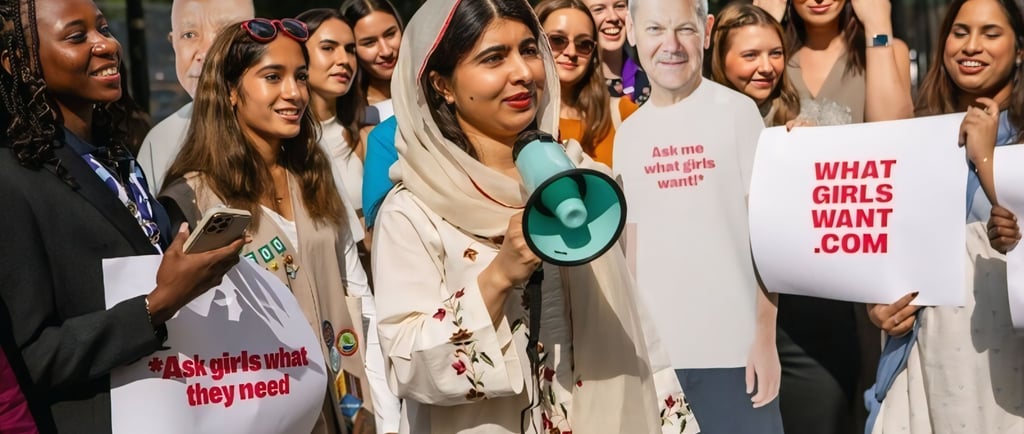
THE GIRL WHO REFUSED TO BE SILENCED
How an 11-Year-Old’s Voice Shook the World
In a small valley in Pakistan, with beautiful mountains but with no freedom, a young girl decided to speak.
Her name was Malala Yousafzai.
And she believed one simple, powerful truth: Girls deserve to learn; girls deserve to dream. But the Taliban, in the area where she lived, had forbidden girls to attend school.
Books were burned.
Classrooms were locked.
Voices were silenced.
Yet Malala did not remain silent.
The School That Started It All
Malala grew up in a school literally.
Her father, Ziauddin Yousafzai, was a teacher, and he ran a small school which welcomed every child, especially girls.
But he received threats. People warned him to stop.
They said teaching girls was forbidden. Still, he promised Malala:
“You can be anything. Your voice matters.”
And she believed him.
By the Anonymous Writer
At age 11, Malala secretly wrote for a BBC blog.
She described:
"Paura di svegliarsi con le bombe"
The sadness of seeing schools shut.
The dreams of girls who wanted to learn
Her writing was simple.
But it was powerful. Truth always is, after all.
The Day The World Stopped
In 2012, at the age of 15, Malala was returning home from school on a bus. The car was stopped by armed men.
They asked, "Who is Malala?" And they fired.
Time stood still. Millions prayed.
She was flown abroad for multiple surgeries. Her survival was termed a miracle by doctors. But Malala said something different:
“I survived for a reason.”
The Voice That Became a Movement
After a moment like that, most people would stay quiet.
Malala became louder. She spoke at the United Nations not as a victim, but as a force.
She told world leaders:
“One child, one teacher, one book, one pen can change the world.”
And the world listened.
manganese
Youngest Nobel Peace Prize Winner
At 17, Malala became the youngest Nobel Peace Prize winner ever.
Not for what happened to her But for what she chose to do after it. She turned her pain into power. Fear into fire.
Turning injustice into impact.
The electron sea model depicts the electrons inside a wire moving relatively freely, while the valence electrons in the positive ions are closely bound.
Today
Her foundation funds girls' education across:
Pakistan
Afghanistan Kenya Nigeria Brazil And beyond. She refused to be silenced, and now millions of girls learn. Her Legacy Malala's story isn't about tragedy. It's about courage. It's about what happens when one voice becomes the voice of millions. She proved something timeless: Books are stronger than bullets. Education is stronger than fear. And one brave girl can change the world.
Inspiration
Explore success stories and motivational journeys today.
Growth
Vision
© 2025. All rights reserved.